Village and buildings
Every building has a level (upgraded with specific materials) and takes up one or more village slots — the Town Hall decides how many slots you have and how far you can level up other buildings (one step past its own current level).
- Town Hall: max level 7, decides available slots
- Other buildings: max level 5
- "Large" buildings (e.g. the Monument): 2 slots instead of 1
- Military path: mostly Stone and Iron
- Merchant path: mostly Wood
- Prestige path: mostly Crystal and Relic
Heroes and permadeath
Every hero belongs to a class, which decides how they behave in battle. Ten classes, each with a different role:
- Warrior: a heavy blow every 3 turns. With roles on, leaves a Wound that lowers the target's defense.
- Mage: hits ALL enemies at once, for 65% of attack. Leaves scorched ground that keeps burning.
- Archer: frequent criticals. With roles on, the critical charges every 4 hits instead of being random.
- Rogue: dodges one hit in five and targets the weakest enemy. After a kill, vanishes then lands a sure critical.
- Healer: heals the most wounded ally instead of attacking. Can heal over time, useful in long fights.
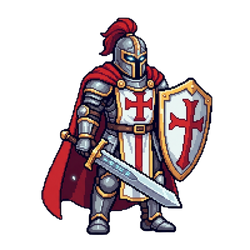
- Paladin: draws hits and shields an ally, absorbing part of the damage they would take.
- Necromancer: curses the strongest enemy to lower its attack, and poisons it each turn.
- Berserker: more damage the less health remains. He gives up defending to hit harder: keeping him low on HP is a gamble.
- Bard: amplifies team synergies. Weak alone, precious in a group.
- Shaman: removes one negative effect from an ally and one positive from an enemy. He undoes instead of casting.
Beyond their class a hero may have an extra ability, assigned at random on summon: the Academy lets you reroll it for Crystal, with no class restriction and stronger than normal.
Death is permanent in the Dungeon, the Pit, and daily boss challenges. Map marches and the Arena never kill anyone.
Elemental families and team synergies
Every hero and enemy belongs to one of five elemental families — Furia, Natura, Gelo, Ombra, Luce — arranged in a cycle where each one beats the next and is beaten by the previous. Facing the family you beat deals more damage; facing the one that beats you deals less. No family is the best on its own, so there's no single ideal team.
Composition matters just as much as the heroes themselves:
- Cohesion: two or more heroes of the same class reinforce each other
- Harmony: three or more heroes of the same elemental family amplify their advantage when the wheel favors them
- Vigil: Paladin and Healer together heal more
- Ruin: Warrior and Necromancer hit harder together
- Ambush: Archer and Rogue hit harder together
- Execution: Mage and Rogue hit harder together
The wheel punishes bringing a single-family team against the wrong enemy: no strategy dominates on its own.
The elemental wheel
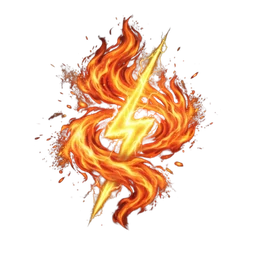 Fury
Fury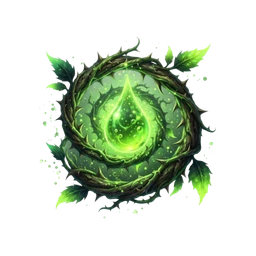 Nature
 Frost
Frost Shadow
 Light
Light
Each element beats the next and fears the one before. The cycle closes: Light beats Fury.
How combat works
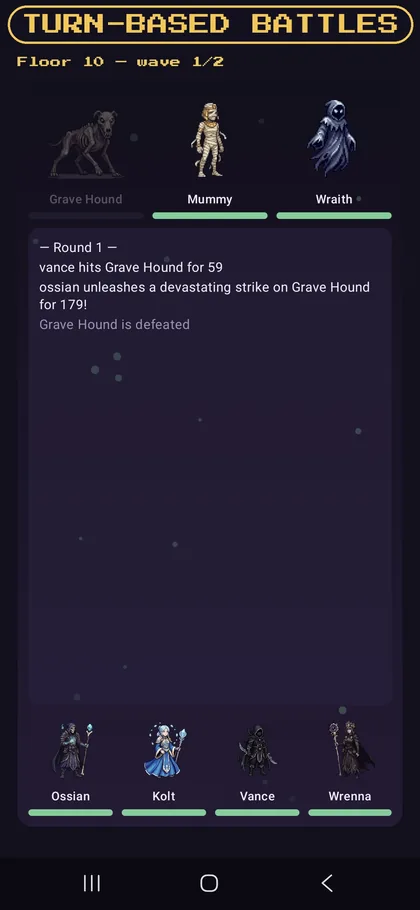
Each turn, whoever has the highest Speed acts first, recalculated every round. Every class has its own AI (Warriors land a heavy strike every 3 turns, Mages hit every enemy, Healers heal the most wounded ally, and so on) — see the "Class roles" section below for effects that outlast the hit itself.
Damage depends on Attack and Defense, with a small random variance. The server always computes the entire battle BEFORE you see it: marches, dungeon runs, daily bosses and Arena duels are all decided server-side, your phone just animates what already happened — so two devices can never see different outcomes for the same fight.
Class roles
Beyond class and synergies, every role leaves a mark that lasts past its own turn, not just the instant of the hit:
- Warrior — Wound: every third hit leaves the target more exposed for a few turns.
- Healer — Blessing: can heal over time instead of only in a single burst, useful in long fights.
- Necromancer — Blight: the curse now also carries a poison that builds up on the target.
- Mage — Scorched Ground: the area attack leaves the ground burning, still hurting whoever remains in it.
- Paladin — Oath: can protect an ally, redirecting part of the damage onto themselves.
- Archer — Aim: the critical charges up instead of being random, landing every few hits for sure.
- Berserker — Rage: more damage the less health he has left. He gives up defending to hit harder.
- Bard — Refrain: amplifies the team synergies already active. Weak alone, precious in a group.
- Shaman — Dispeller: removes one negative effect from an ally and one positive from an enemy. He undoes instead of casting.

Dungeon and the Pit
Each floor is split into one or more monster waves: your heroes' HP carries over from the previous wave, it doesn't regenerate between waves on the same floor. You can retreat between waves — you keep the XP earned but not the floor reward. A hero who dies in the Dungeon is lost forever.
Each run on a normal floor costs a torch — a personal resource, whose cap and regeneration depend on your War Hall's level, not shared with the guild. The Pit uses the same torches to take on floors well beyond your real progress — same permadeath risk, but richer loot.
World map and marches
On the map you can occupy free resource zones, attack those of other players, or raid another village directly. Every expedition has a real march time (outbound and, for attacks, the return too): heroes on the march stay busy and cannot be used elsewhere until they come back. The battle resolves on its own upon arrival, even with the app closed: you will find the outcome in the battle log.
RAIDS AGAINST YOU: a successful raider takes real materials from you. Part of your storage is always untouchable though: 20% of your Warehouse capacity, plus whatever Walls and Watchtower add (up to 75% in total). Everything above that threshold can be taken, so spending beats hoarding. Gems and Relics are never raidable.
When you see an incoming attack you can still reinforce your garrison: what counts is the one you have when they arrive, not the one from when the enemy set off. After being raided you get 8 hours of protection: nobody can hit you again in that window.
Map events
Every so often something appears on the map that wasn't there before, and it only stays for a few hours. Send a team before it fades.
- Ruins: a fight, and the first to take them gets everything — whoever arrives second comes back empty-handed. Drops materials and OBSIDIAN.
- Unstable Portal: a fight, but everyone faces their own: not a race. Harder than the Ruins and more generous. Drops materials and OBSIDIAN.
- Something happened here: no fighting, one hero is enough. On the way back a card tells you what you found. Drops materials and ORICHALCUM, and the rarest tier can drop a piece of equipment.
- The Tree of Life: rare, one every two weeks, and it's a race. Drops a LIFE SEED, which brings back a fallen hero.
- Wandering Caravan: a passing merchant, one hero is enough. Trades at better rates than the Mint, once per offer. Drops ORICHALCUM.
- The Royal Messenger: doesn't appear on the map and needs no team. He passes a couple of times a week, at unpredictable hours, and leaves a gift in your Mail: gems, materials or relics. Claim it within six hours, or he moves on.
The battle resolves on arrival by itself, even with the app closed: you'll find everything in the battle log, under the Events tab, where you can reopen cards you've already read.
Upgrades and new materials
Map events bring three materials you can't find anywhere else:
- Obsidian: upgrades WEAPONS. Dropped by events where you fight — Ruins and Unstable Portal.
- Orichalcum: upgrades ARMOR. Dropped by events where you find something without fighting — Mystery and Caravan.
- Life Seed: brings back one fallen hero of your choosing, from the Fallen screen. It only works on those who have rested at least seven days: for a recent loss, paid revival remains. Only the Tree of Life drops it.
Upgrading is piece by piece, up to +5: THAT sword becomes +1, not every sword like it.
- Each level: +8% to the piece's stats, up to +40% at maximum.
- Rising cost: 5, 12, 25, 45 and 68 units for a Common piece. The last level costs more than the first three together.
- Piece rarity: a Rare costs twice a Common, an Epic three times. Better to choose what to invest in than to upgrade everything.
The slowness is deliberate: maxing out your main team's gear is a goal measured in months, not weeks.
Arena
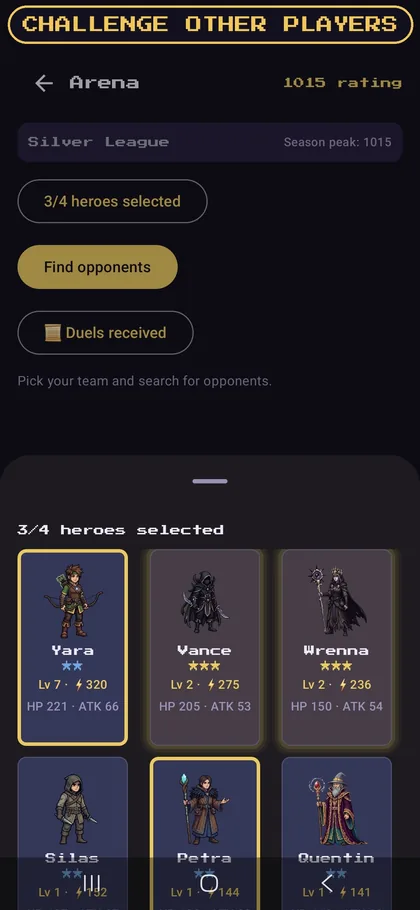
Ranked PvP duels: pick your defense team first, then search for three opponents proposed based on power and rating (a short cooldown between searches, and a limit of 20 duels a day, keep it from being farmed). If too few real players are in your power range, bot villages fill the gap — they stop appearing as soon as enough real opponents are available. Winning or losing shifts your rating Elo-style: beat someone with a much higher rating and you gain almost the maximum, beat a beginner and you gain almost nothing. Each league is split into three divisions (III to I), so you can see yourself climbing even within the same league. Duels themselves pay no gems: winning enough of them in a season unlocks gem milestones, and the big reward comes at the end of each month-long season, scaled to the highest league your peak rating reached (not the final result, so a late loss can't cost you the tier). Check the global leaderboard to see where you stand. Nobody's heroes are ever at risk in the Arena.
Guild and Alliance
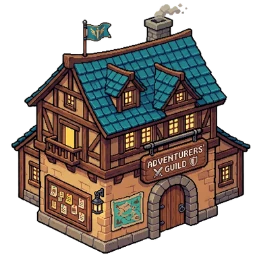
You can found a guild or join an existing one (open or approval-only), independently of the Adventurers' Guild building — that building only unlocks solo missions (idle expeditions for your heroes), not the alliance.
In a guild you can help guildmates speed up constructions, contribute to the shared alliance boss, chat, and found a guild Stronghold on the territory.
Guild wars
Only the guild leader can declare war on another guild (which must have at least 3 members) or respond to a declaration received. Until accepted, the war stays pending indefinitely — you can decline it to cancel it entirely.
Once accepted it lasts exactly 7 days: during that time every won raid, captured tile, or attack on the enemy Stronghold earns points for your guild and for you personally. Whoever has more total points at the end wins, and every member of the winning guild collects a material reward proportional to their own contribution. There's currently no way to end a war early once accepted: it runs the full week.
Materials, gems and the store
There are five materials, each tied to a different building path:
- Wood: merchant path
- Stone and Iron: military path
- Crystal and Relic: prestige path
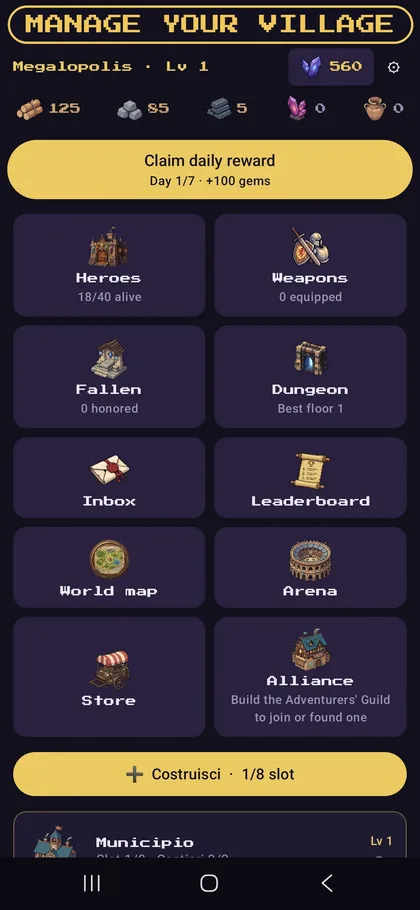
Gems are used to summon heroes and equipment, and come from loot, the daily reward (growing up to 7 consecutive days), and real purchases. The Shop offers gem and material bundles for real money, plus a rotating daily deal with an extra bonus.
Frequently asked questions
Can dead heroes be recovered?
Yes. A fallen hero goes to the Fallen list and can be revived with gems, as long as you have a free slot in the Dormitory. Death is permanent only in the Dungeon, the Pit and the daily boss challenges: marches and the Arena never kill anyone.
How much can I lose in a raid?
Only what sits above the protected threshold: 20% of your Warehouse capacity, plus whatever Walls and Watchtower add, up to 75% in total. Gems and Relics are never raidable, and after being raided you get 8 hours of protection.
How do the elemental families work?
Fury, Nature, Frost, Shadow and Light form a cycle: each deals more damage to the next and takes more from the previous one. No family is best on its own, so there is no universally ideal team.
Is combat automatic?
Yes, the battle resolves on its own and is computed entirely on the server: your decisions come earlier, in team composition, gear and deployment order.
Do I need a guild to play?
No, but it changes a lot: a guild gives building help, the guild boss, the shared treasury with its research, and access to wars between alliances.
Is Wish & Fall free?
Yes, it is free on Google Play. There are optional purchases of gems and materials, but nothing is required to progress.